Your product needs design work, and the team is split. One founder wants to hire a designer, the other found a freelancer on Contra, and someone forwarded an agency’s site. Three options, three very different prices, and no shared way to compare them.
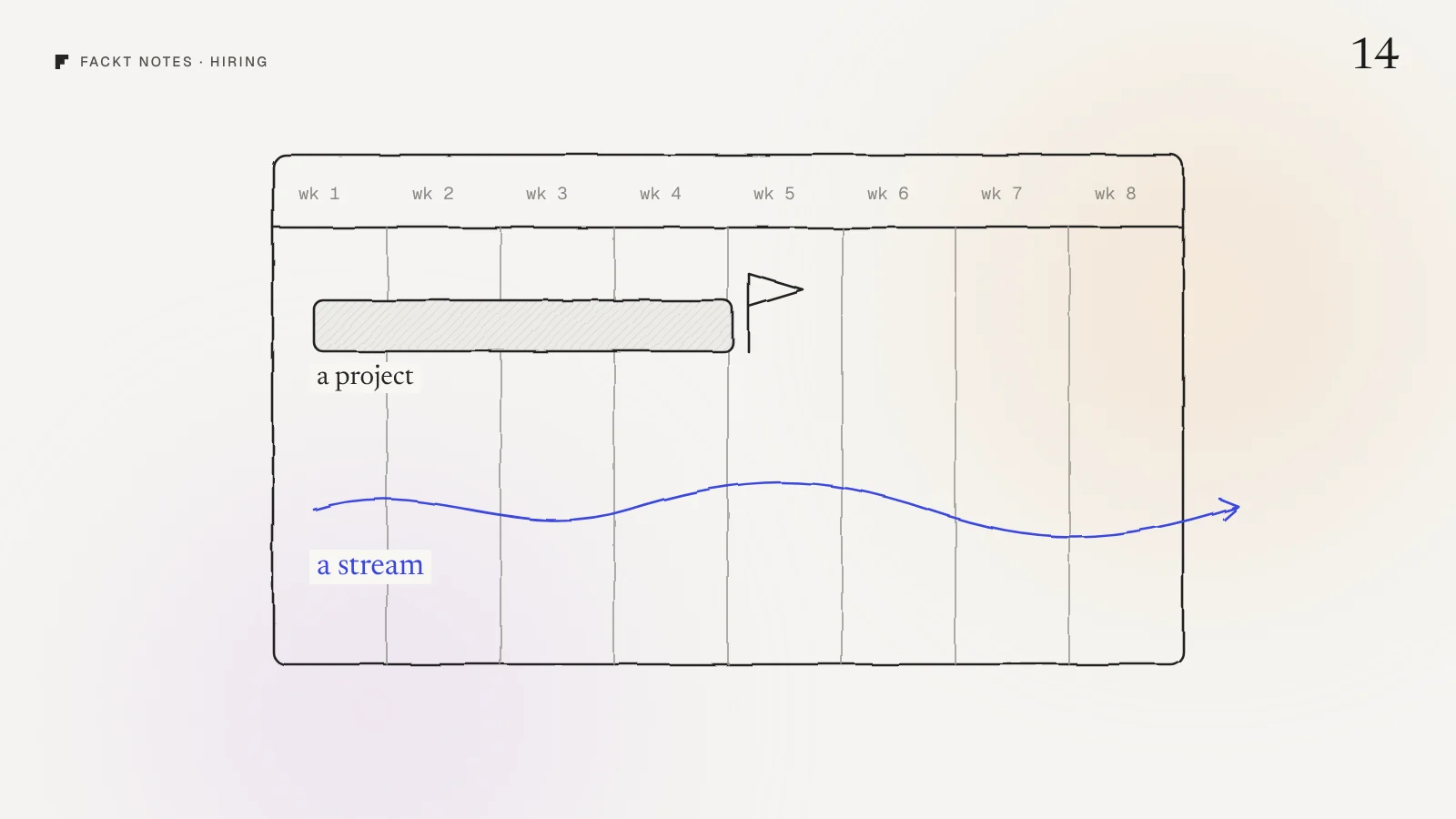
The right choice is not about the hourly rate. It depends on whether your design work is a project with an end, or a stream that never stops. Projects suit an agency or a freelancer. Streams suit a person on your team, or a retainer until you are ready for one.
Here is how we would think about it, as an agency that works next to freelancers and in-house teams.
Start with the shape of the work
Write down the design work you expect in the next six months. Then look at its shape:
- A project has a start, a finish line and a clear result: redesign the dashboard, rebuild onboarding, launch the new site, design the app.
- A stream never finishes: new features every sprint, experiments every week, a growing product that needs someone who remembers why every screen looks the way it does.
Most early SaaS teams have one big project followed by a stream. That is why the answer often changes over time.
When an agency fits
An agency fits a project that needs more than one skill, or needs to start next week.
- Several skills at once. A redesign often needs product thinking, UI, copy, a landing page and sometimes motion. An agency brings them together without four hires.
- Speed. No hiring process. A good agency starts with a call and shows real screens in the first weeks.
- Fresh eyes. An outside team sees what the inside team stopped noticing. When we redesigned FireCut, we started by reading 100 cancellation responses and traced 68 of them to design problems the team lived with every day.
The risk is handoff. When the project ends, someone has to own what was designed. Ask any agency how they hand over: files, specs, a design system, a walkthrough.
When a freelancer fits
A freelancer fits narrow, well defined work that someone on your team can direct.
- Clear scope. Twenty screens in an existing design system, a set of icons, a landing page with copy already written.
- A director on your side. A freelancer is usually one person executing a plan. If nobody on your team owns the plan, the work drifts.
The risk is that everything depends on one person: holidays, other clients, availability. For small, clear jobs that is fine. For the core of your product it is a gamble.
When in-house fits
Hire in-house when design is a stream and someone needs to own the product’s experience every day.
- Daily context. An in-house designer sits in every product discussion, knows the users and the data, and keeps decisions consistent.
- Ownership. Someone wakes up thinking about onboarding and retention, not about the next client.
The risk is timing. A first designer hired before the foundations exist spends months on basics: the design system, the brand, the key flows. Many teams get more out of hiring after an agency has set those up, so the hire starts on a clear base.
The option in between: a retainer
Many SaaS teams have a stream of design work that is too big for occasional freelancers and too small, or too early, for a full-time hire. A retainer covers that gap: a steady team working through your requests, without a hiring process, that you can pause when things slow down.
Many of our clients start this way: a fixed project first (from $5,000) to fix the biggest problem, then a monthly retainer ($6,900) once design becomes a weekly need.
Decide in ten minutes
Answer three questions:
- Is the next six months of design a project with an end, or a stream?
- Does anyone on your team own design decisions today?
- Do you need one skill, or several at once?
A project with several skills and nobody owning design points to an agency. A narrow project with a strong owner points to a freelancer. A stream with daily decisions points to in-house, often after the foundations are set.
Why this is hard to see from the inside
When design is slow or inconsistent, it looks like a people problem: we need a designer. Often it is a shape problem: the work is a project being treated as a stream, or a stream being handled as one-off projects. Getting the shape right usually matters more than who does the work.
If you want an outside view on what your product needs, start with the free audit: a video walkthrough and a written list of fixes, within 2 days, so you know the size of the work before you choose who does it.
Quick answers
Should a SaaS startup hire a designer or an agency?
If you have a defined project with an end, like a redesign, a new onboarding or a launch, an agency or a strong freelancer is faster. If design work arrives every week and someone needs to own the product's experience, hire in-house, often after an agency has set up the foundations.
When is a freelancer better than an agency?
When the work is narrow and well defined, like a set of screens in an existing design system, and you have someone on the team to direct it. Agencies fit better when you need product thinking, several skills at once, or a team that does not depend on one person.
Is a design retainer worth it for a SaaS?
When design work arrives every week but not enough to fill a full-time role, yes. A retainer gives you a steady team without hiring, and you can pause it when the work slows down.
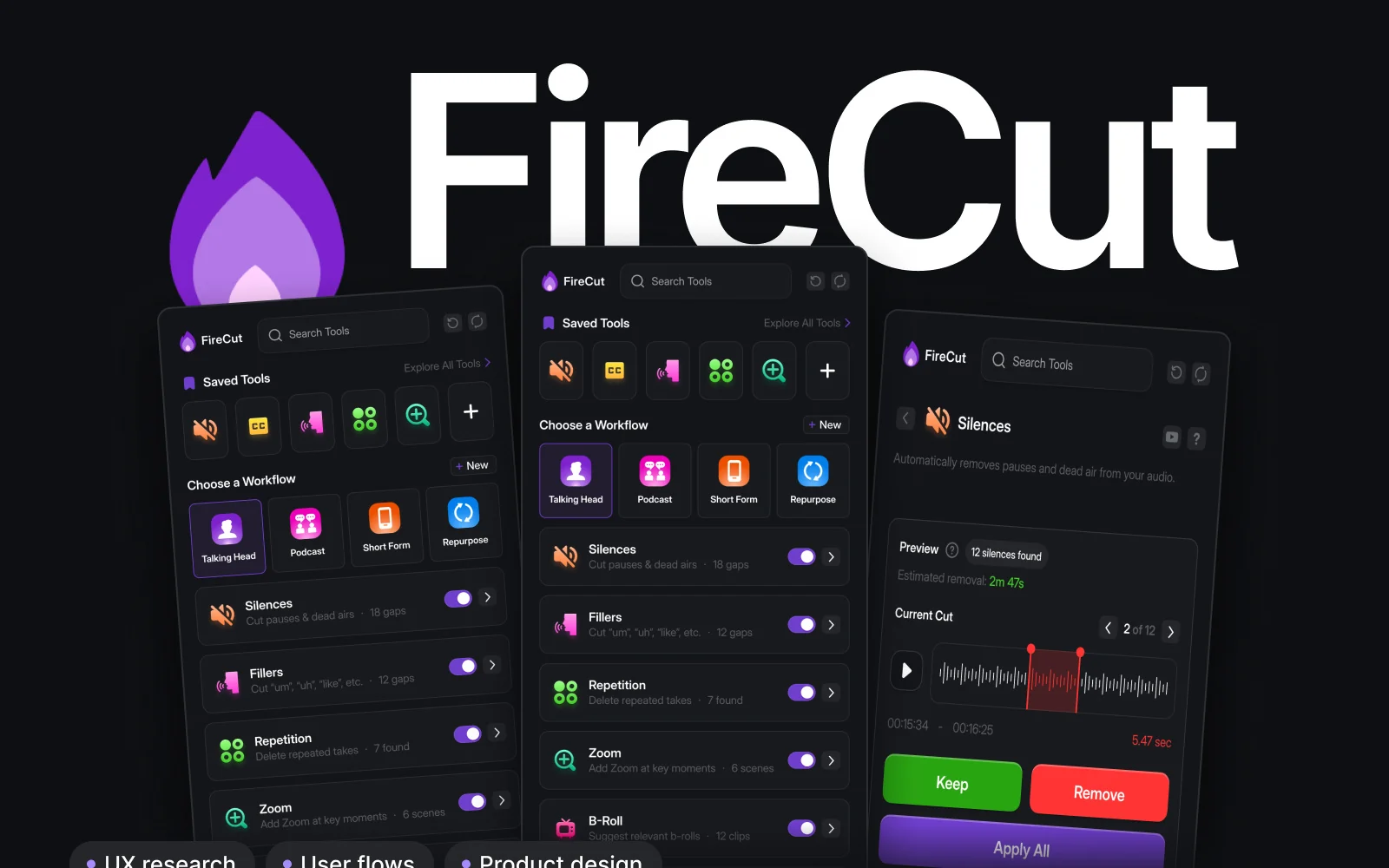 Case studyFireCut: Product designA UX redesign of an AI editing plugin for Premiere Pro, turning a flat grid of 12 tools into one clear flow, starting from 100 cancellation responses.