A SaaS redesign has no list price, which is why every quote you get looks different. One studio says $8,000, another says $60,000, and both can be honest, because they are pricing different things.
For a specialist studio, redesigning one core flow of a SaaS product costs about $6,000 to $18,000, and redesigning the core product costs about $12,500 to $38,000. Freelancers come in lower and large agencies higher. Below is how those numbers are built, so you can check any quote against them.
The short answer
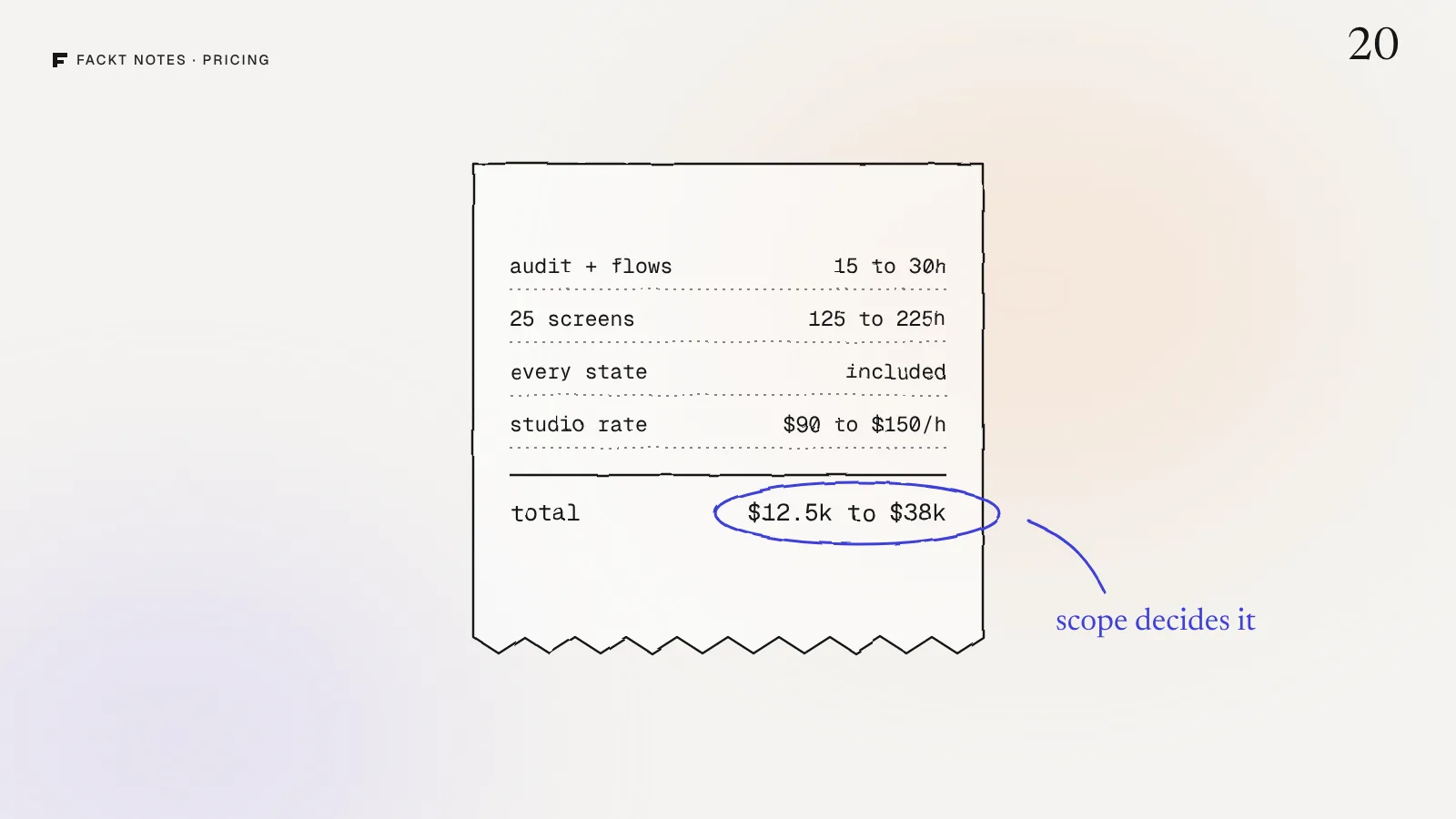
These ranges use the same hour model as our website cost calculator: 5 to 9 hours of design per product screen, including its empty, loading, error and success states, plus time for the audit and the flows before any screen is drawn.
| Scope | Freelancer | Specialist studio | Large agency |
|---|---|---|---|
| One core flow, about 10 screens | $2,500 to $11,000 | $6,000 to $18,000 | $10,000 to $30,000 |
| Core product, about 25 screens | $5,500 to $23,000 | $12,500 to $38,000 | $21,000 to $64,000 |
| Full product with a design system, about 40 screens | $10,000 to $42,000 | $23,000 to $70,000 | $38,000 to $117,000 |
Hourly rates behind them: about $40 to $90 for a freelancer, $90 to $150 for a specialist studio and $150 to $250 for a large agency. The spread inside each cell is mostly how complex the screens are. A settings page is quick. A dashboard with filters, charts and permissions is not.
At Fackt, the free audit costs nothing, fixed-scope projects start from $5,000 and run 2 to 6 weeks, and a monthly retainer is $6,900. More on how we price product work in how much SaaS product design costs.
What you are actually paying for
A redesign is not new paint on old screens. The money goes to four things.
1. Finding out what is broken. Session recordings, support tickets, analytics on the steps where people drop off, and a review of every screen in the flow. This is 15 to 30 hours on a core product, and it is the part that decides whether the rest pays off.
2. Flows before screens. Agreeing how a user gets from sign up to first value, and what each screen is for, before anyone opens a high fidelity file. Changing a flow on paper costs minutes. Changing it after the UI is done costs days.
3. Every screen, in every state. A table is not one design. It is the table with data, with no data, while loading, with an error, with a hundred rows, and on a phone. Most of the hours live here, and it is the part cheap quotes leave out.
4. Handoff your developers can build from. Components, specs and answers to questions while they build. A redesign that cannot be built as designed is the most expensive kind.
What makes a redesign cost more
- Real users already rely on it. Redesigning a live product takes more care than designing a new one. You cannot move a button people use every day without a reason and a plan.
- No design system. If every screen was built slightly differently, the redesign has to create the system first. That is often 40 to 80 hours on its own, and it pays back on every screen after.
- Complex data. Dashboards, permissions, billing and anything with many roles take longer per screen than marketing style pages.
- A tight deadline. Work that has to run in parallel takes more design time each week.
How to keep the cost down without cutting corners
- Redesign the flow that costs you most first. Usually onboarding or the main dashboard. You get a result you can measure before you commit to the rest. Our SaaS dashboard audit checklist helps you find it.
- Decide if it is a redesign at all. Sometimes the screens are fine and the code is the problem, or the other way round. We wrote about that in redesign or refactor.
- Write the goal as one sentence. “We want more trial users to connect their first data source.” A goal like that decides what is in scope and what is not, and it makes quotes comparable.
- Reuse what works. Keep the parts users already understand. A redesign that changes everything also makes everyone learn everything again.
Agency, freelancer or in-house for a redesign?
A redesign is a project with an end, which is what agencies and strong freelancers are built for. A freelancer is the cheaper choice when the scope is narrow and someone on your team can direct the work. A studio fits when you need research, product thinking and UI at once, on a fixed date. Hiring in-house makes sense once design work never stops. The full comparison is in design agency vs freelancer vs in-house.
Get a number for your product
Send us your product for the free audit. Within 2 days you get a video walkthrough of where users get stuck and a written list of fixes, ordered by impact. That list is also the scope for a redesign, so the quote that follows is based on your screens, not a guess. See how we work on SaaS product design.
Quick answers
How much does a SaaS UX redesign cost?
For one core flow of about 10 screens, expect roughly $2,500 to $11,000 with a freelancer, $6,000 to $18,000 with a specialist studio and $10,000 to $30,000 with a large agency. Redesigning the core product, around 25 screens, runs about $5,500 to $23,000, $12,500 to $38,000 and $21,000 to $64,000. A full product with a new design system costs more again.
How much does a SaaS product redesign cost with a design agency?
With a specialist SaaS design studio, a focused redesign of one flow usually costs $6,000 to $18,000 and the core product $12,500 to $38,000. At Fackt, fixed-scope projects start from $5,000 and take 2 to 6 weeks, and a monthly design retainer is $6,900.
How long does a SaaS redesign take?
A single flow takes 2 to 3 weeks. The core product usually takes 4 to 6 weeks. A full product with a new design system takes 2 to 3 months, often run as a retainer so it can ship in stages.
Is it cheaper to redesign one flow at a time?
Usually, yes, and it is less risky. Redesigning the flow that costs you the most, like onboarding or the main dashboard, gives you a result you can measure before you commit to the rest.